Key takeaways
- For permitted development in England, an air source heat pump, including an air-to-air unit that cools as well as heats, must produce 37 dB(A) or less at every neighbouring habitable-room window or door.
- The MCS 020 a) calculation uses the unit’s sound power, the hard surfaces around it, the distance and any solid barrier.
- Each extra reflecting surface adds about 3 dB. Doubling the distance takes about 6 dB off. A solid fence that hides the unit can take off up to 10 dB.
- The 37 dB(A) limit has applied to permitted-development installs since 20 September 2025, replacing the older 42 dB(A) figure.
Cooling a home in a heatwave means an outdoor unit, and the outdoor unit of an air conditioner or heat pump has a fan and a compressor that neighbours can hear. That is why noise is written into the rules. For an air source heat pump to be permitted development in England, it has to pass a standard calculation, and since September 2025 the bar is lower than most guides still say.
The rule in one sentence
Using the method in MCS 020 a), the predicted sound level must be 37 dB(A) or less at every assessment position: 1 metre outside the centre of any window or door to a habitable room in a neighbouring home, measured straight out from it.
“the permitted development noise limit of 37 dB LAeq,5mins”
How the calculation works
- 1
Take the sound power from the datasheet
The A-weighted sound power level (LWA) of the outdoor unit, in dB(A). Quieter models are often around 55 to 60 dB(A). - 2
Count the reflecting surfaces
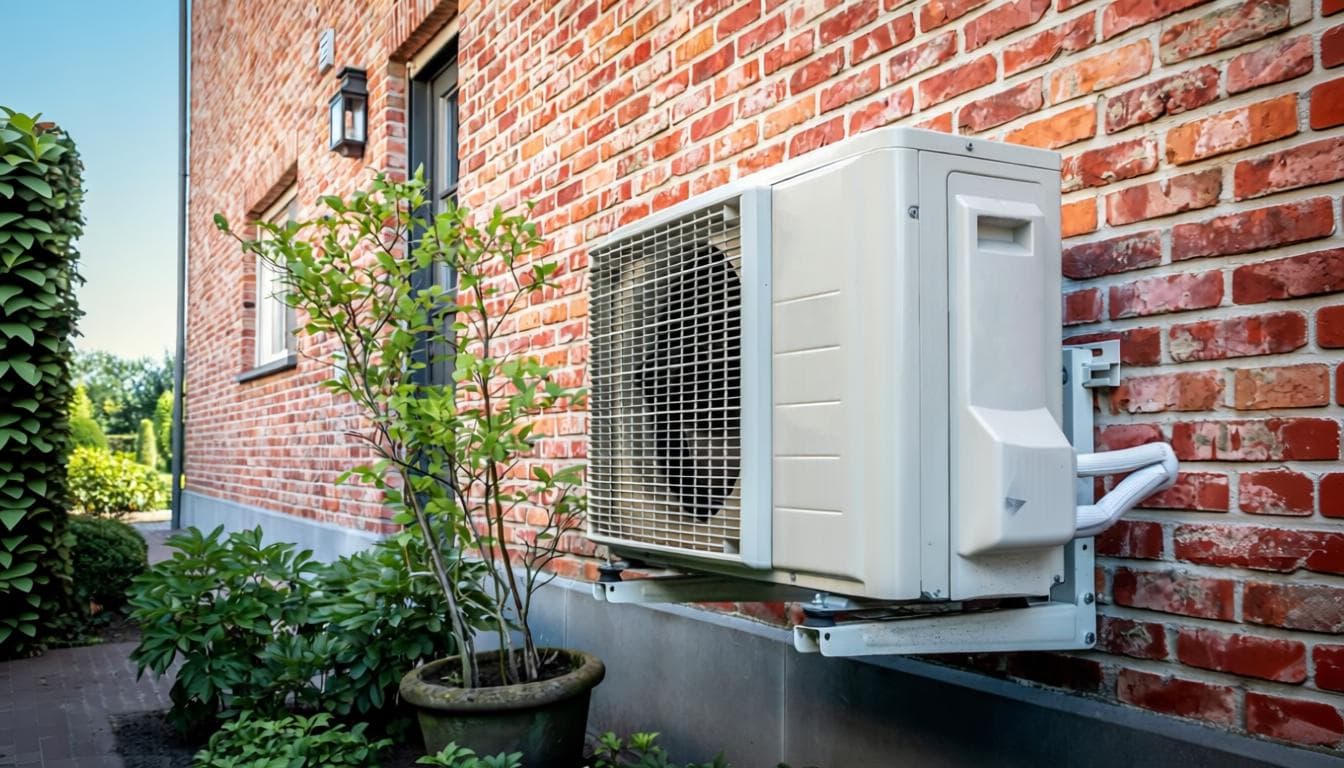
Hard surfaces within 1 metre that extend at least 1 metre beyond the unit: the ground, a wall, a second wall. One surface gives a directivity of 2, two give 4, three give 8. More than three, as in a lightwell, cannot pass. - 3
Measure the distance
In a straight line from the centre of the unit to the assessment position, to the nearest 0.1 metre. - 4
Allow for a barrier
A solid wall or fence at least 18 mm thick takes off 10 dB if it completely hides the neighbour’s window from the top of the unit, or 5 dB for a partial view. A thinner solid fence takes off 5 or 2.5 dB. - 5
Work out the level and compare
Level = sound power + 10 x log10(directivity / (4 x pi x distance squared)) - barrier. Round to 0.1 dB. At or below 37 dB(A) passes.
Worked examples
| Set-up | Predicted level | Result |
|---|---|---|
| 58 dB(A) unit, on the ground against one wall, 6 m away, full view | 37.5 dB(A) | Fails |
| The same, behind a solid fence that hides it | 27.5 dB(A) | Passes |
| 58 dB(A) unit in a corner (three surfaces), 4 m away | 44.0 dB(A) | Fails |
What gets a unit under the limit
- Distance. Doubling the distance to the neighbour’s window takes about 6 dB off.
- Fewer hard surfaces. Moving a unit out of a corner, from three surfaces to two, takes about 3 dB off.
- A solid barrier that blocks the line of sight, such as a masonry wall or a solid, gap-free fence.
- A quieter model. Sound power varies by several decibels between otherwise similar units.
Frequently asked questions
What is the noise limit for a heat pump in the UK?
For permitted development in England, 37 dB(A) at the nearest neighbouring habitable-room window or door, calculated using MCS 020 a). It has applied since 20 September 2025.
Is it 37 dB or 42 dB for heat pumps?
The current MCS 020 a) standard uses 37 dB(A). The 42 dB(A) figure belongs to the older MCS 020 method it replaced.
Does a fence reduce heat pump noise?
A solid, gap-free barrier that hides the neighbour’s window from the top of the unit can take 5 to 10 dB off in the calculation. Open or gappy fences and hedges do not count.
Sources
Solomon Amos, Founder & Technical Architect, GetComfort
Solomon Amos is the founder and technical architect of GetComfort, and built HomePortfolio, the property-intelligence platform behind this site's property data. He is not an installer: every accreditation and planning claim here is sourced to its primary guidance, as the methodology sets out. More about the author